
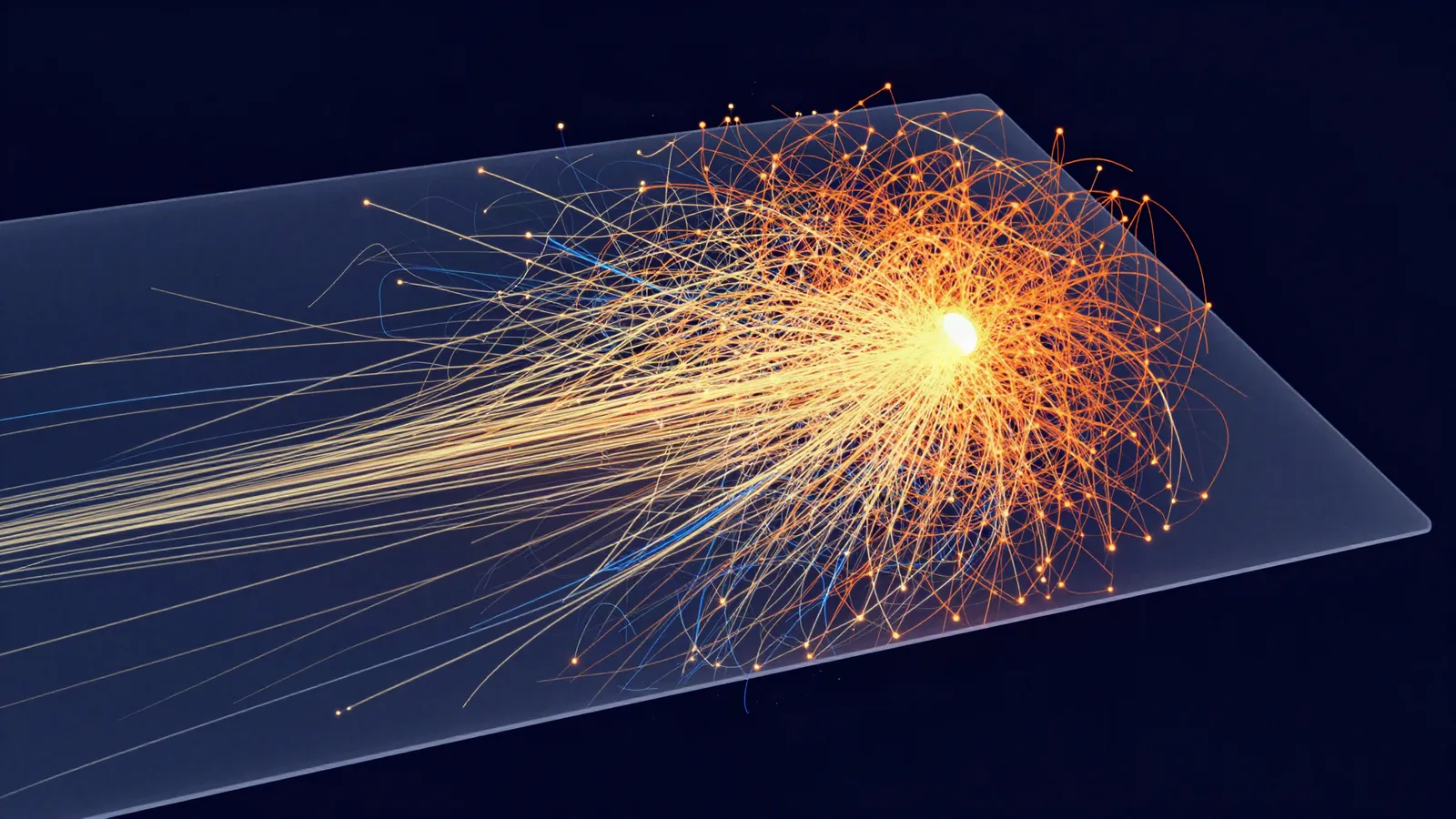
Three Paths for an Incoming Photon
A photon can pass through the object without an interaction, be absorbed, or scatter. A photon that travels through the object without changing direction contributes to the transmitted primary beam. An absorbed photon transfers energy in the material. A scattered photon leaves the original direction and may reach the detector, another part of the object, or the surrounding room.
Absorption and scatter both reduce the primary beam. That reduction is called attenuation. The probability of an interaction depends on photon energy and the material in its path. Increasing the thickness generally increases the chance of an interaction.
How Interactions Affect the Image
Differences in attenuation between neighboring paths produce differences in the primary signal reaching the detector. Those differences carry information about the object. Scatter can add a signal that is less closely tied to its original path. In projection imaging it can reduce subject contrast, especially when a large volume contributes scatter.
Two useful interactions to recognize are photoelectric absorption and Compton scattering. In photoelectric absorption, the incident photon is absorbed and an electron is released from an atom. In Compton scattering, a photon transfers part of its energy to an electron and continues in another direction with reduced energy. The relative importance of these interactions varies with energy and material.
When an Exponential Model Applies
For a narrow beam of photons of one energy passing through a uniform material, the unscattered intensity follows I = I₀ × exp(−μx). Here I₀ is the incident intensity, μ is the linear attenuation coefficient, and x is material thickness. The units of μ and x must make their product dimensionless. With this model, the half-value layer is ln(2) divided by μ.
Diagnostic x-ray beams contain a range of energies. A material can preferentially remove lower-energy photons and change the energy spectrum of the remaining beam. This is beam hardening. Scatter reaching a measurement point can also change the measured signal. Keep these conditions in mind when interpreting the simple model.
Worked Example · Counting the Transmitted Fraction
Start with a fictional narrow, single-energy beam and place two identical half-value layers in its path. The first layer leaves half of the primary intensity. The second leaves half of that half, or one quarter of the original intensity. If the starting intensity is 100 arbitrary units, the model gives 50 after one layer and 25 after two layers. These numbers describe transmission in the model.
Key Terms
- Attenuation
- Reduction in the primary beam as photons are removed by absorption or scatter.
- Scatter
- A change in a photon's direction after an interaction.
- Half-Value Layer
- A thickness that reduces a specified beam quantity by half under stated conditions.
Check Your Understanding
Can Two Materials of Equal Thickness Transmit Different Fractions of the Same Beam?
Yes. Their compositions and densities can produce different attenuation coefficients at the beam energies.