Two Questions Guide a Medical Exposure
Justification asks whether the expected benefit of a procedure is sufficient for its purpose. In imaging, this involves the clinical question, the patient's situation, and the options available to the care team.
Optimization asks how to carry out a justified procedure with exposure suited to the task. An image needs enough information to support its intended use. An exposure change that makes that information harder to see can undermine the benefit of the examination. Optimization considers both image quality and radiation dose.
Patients, Workers, and the Public
Patients receive medical exposure as part of care. Protection for patients centers on justification and optimization. Workers may receive occupational exposure while performing their duties. Their protection also uses workplace controls, training, monitoring where appropriate, and the applicable requirements. Members of the public are protected through measures such as facility design and control of exposure outside clinical work areas.
A number used for one group cannot be assumed to apply to another group. Check who the quantity or rule covers, how it is defined, and the purpose it serves. A diagnostic reference level, for example, is a tool for reviewing typical practice under defined conditions.
Time, Distance, and Shielding
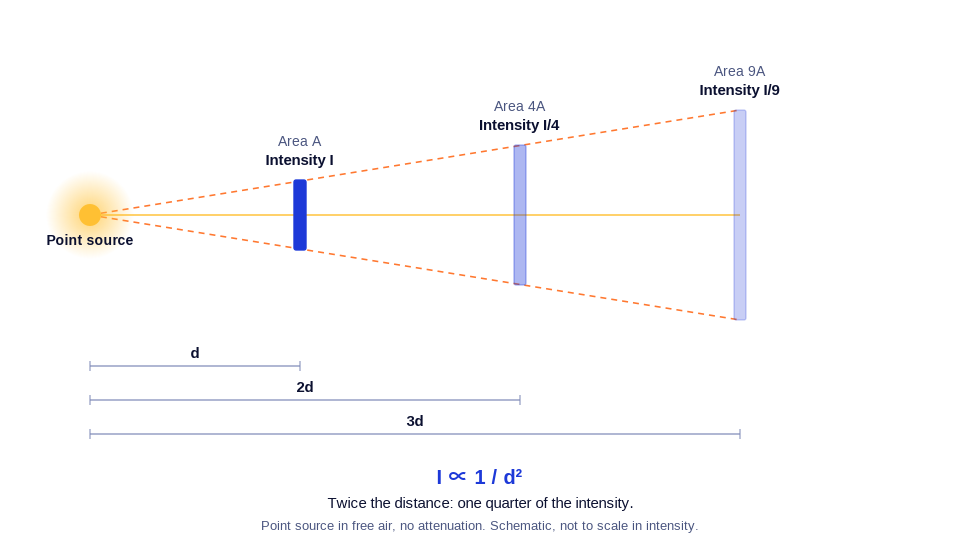
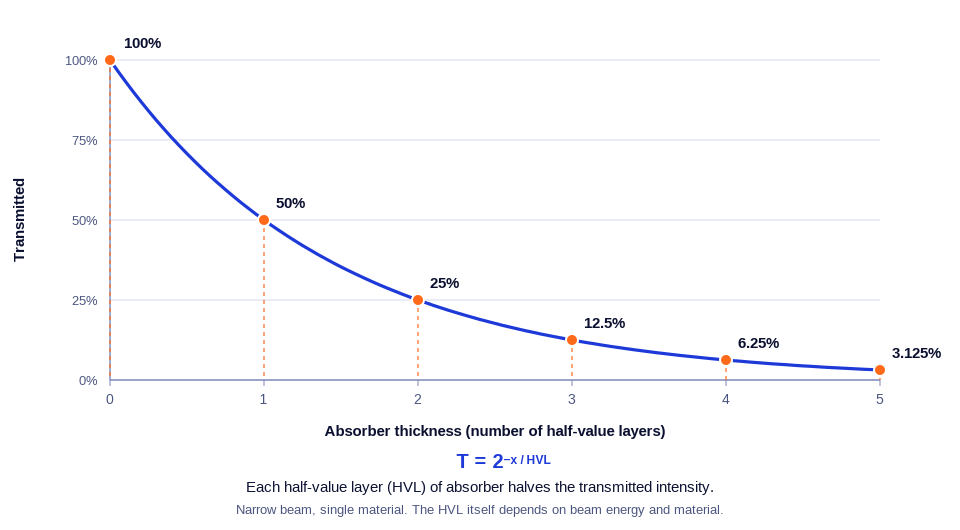
When a source is producing radiation at a steady rate, reducing time in the same radiation field reduces cumulative exposure. In an ideal point-source model, intensity decreases with the inverse square of distance. Shielding reduces transmission through material by an amount that depends on the radiation, material, and geometry.
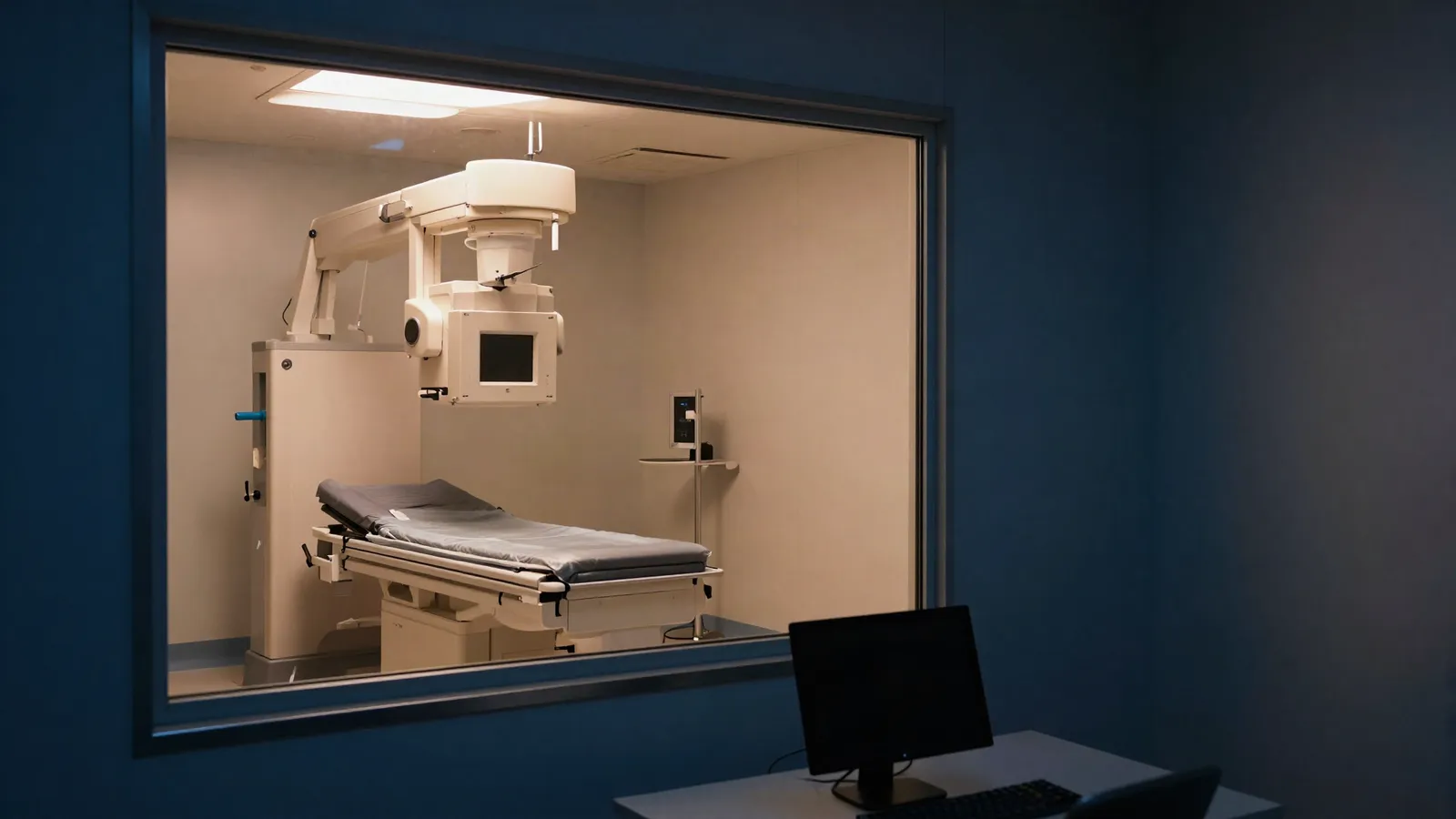
Those relationships explain the controls in Dose Lab. Real imaging rooms can contain several paths for radiation to reach a location. A patient or object can scatter radiation, and equipment position, barriers, and the shape of the beam can change the pattern. Use the simple model to isolate one idea at a time.
Worked Example · Change One Input at a Time
Predict what will happen to the modeled result when you double the distance.
- In the Dose Lab activity below, set the time to 60 seconds, distance to 1 meter, and shielding to zero.
- Record the modeled result. Change only the distance to 2 meters and compare.
- Return to 1 meter, then halve the time to 30 seconds. Compare the result with your original reading.
Compare Your Result With the Model
Doubling the distance gives one quarter of the original result in the point-source model. Halving the time gives half of the original result when the rate stays fixed. Each comparison changes one variable and holds the others constant.