

Image Quality Starts With the Task
An image is useful when it shows the information needed to answer the question being asked. Finding a small bright object, following a moving device, and distinguishing two tissues with similar signals are different tasks. They place different demands on the imaging system.
The same image can be well suited to one task and poor for another. A sharp-looking image may still have enough noise to obscure a faint structure. A smooth-looking image may hide fine detail. Describing the task makes a comparison more informative than simply asking which image looks better.
Four Properties to Look For
- Contrast
- The difference in signal or appearance between an object and its surroundings. A faint object has less separation from its background than a bright object under the same display settings.
- Spatial Resolution
- How well the system preserves small detail or separates nearby structures. Blur from motion, acquisition, or processing can reduce it.
- Noise
- Unwanted variation in the image signal. Noise can make a faint structure difficult to distinguish from variations in the background.
- Artifacts
- Image features introduced by acquisition, reconstruction, processing, or other effects. Examples include motion streaks and unexpected patterns in otherwise uniform regions.
Why Measurements Need Conditions
A resolution or noise number is meaningful only when you know how it was obtained. Slice thickness, reconstruction settings, the test object, and the measurement method can all affect a computed tomography comparison. Some reconstruction methods can affect small or low-contrast objects differently from large, high-contrast objects.
A team may measure image properties using a phantom, a test object with known features. A phantom makes controlled comparisons easier, while a task-based assessment connects those findings to what a person needs to detect or measure. The two types of evidence answer complementary questions.
Worked Example · Two Thin Lines and a Faint Disk
Compare two renderings of the same synthetic test pattern. The first preserves the separation between the fine lines and has a grainy background. The second smooths that background and blurs the edges. Look for the gap between the lines, then look for the faint disk. The two tasks respond differently to the same processing.
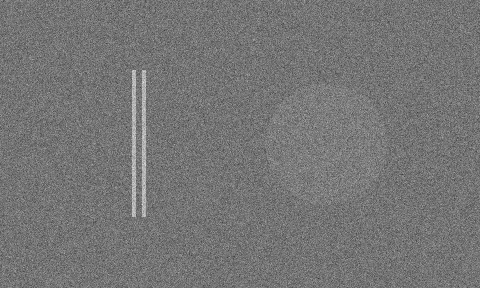 Original pattern with added noise
 Same pattern after smoothing
Key Terms
- Detectability
- How well an observer or method can identify a feature for a defined task.
- Phantom
- A test object with known properties used to evaluate a system.
- Reconstruction
- Calculation of an image from the acquired measurements.
Check Your Understanding
Which Is More Useful by Itself, a Noise Value or a Task Description?
They work together. The noise value describes a measured property. The task description tells you why that property matters and what else to assess.