
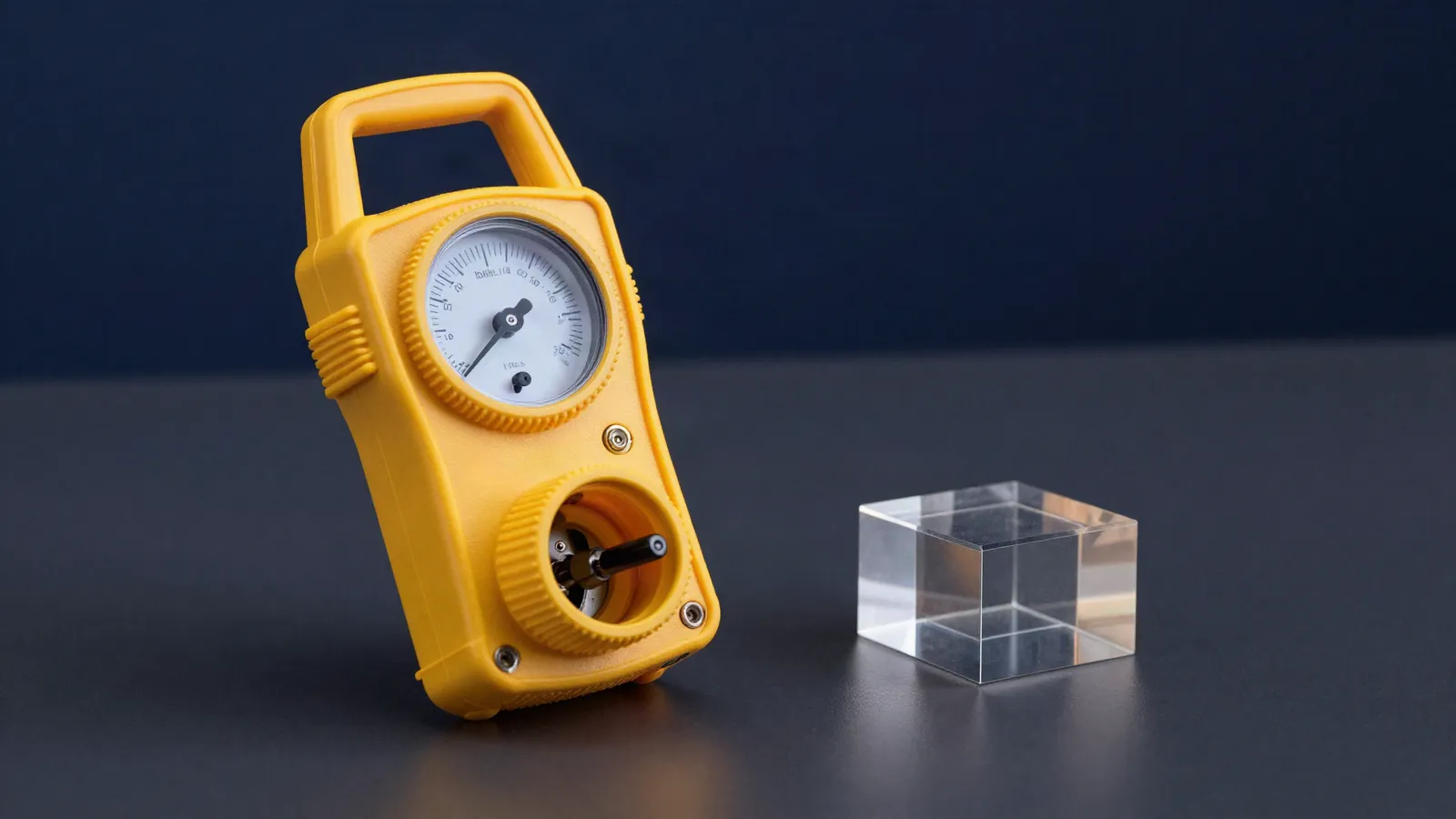
Ask What the Instrument Actually Measures
A wearable dosimeter estimates a specified personal monitoring quantity at its wearing location over a given period. A survey instrument measures a quantity or rate at its position, within the limits of the instrument and its response. A scanner dose display can report a standardized indicator calculated from the acquisition and reference conditions.
Start by identifying the quantity, units, location or time period, and measurement method. For a wearable badge, its placement and exchange period matter. For a survey reading, instrument orientation and the radiation field can matter. For a scanner display, check which indicator the system reports.
What a Scanner Display Can Tell You
A computed tomography display may list volume computed tomography dose index in mGy and dose-length product in mGy·cm. Volume computed tomography dose index characterizes scanner output using a standardized phantom convention. Dose-length product incorporates scan length. These indicators can support comparisons when the relevant acquisition and reference conditions are understood.
Patient or organ dose estimation requires additional information. The indicator alone does not describe dose throughout a specific person's body. Radiant Medical Physics Specialists’ computed tomography dose article explains these quantities and the difference between a scanner indicator and a patient-specific estimate.
Uncertainty Belongs With the Result
Every measurement has limitations. Repeat readings may vary because of instrument noise, positioning, or changes in the source. Calibration, corrections, and the way the quantity is defined can also contribute uncertainty. Averaging repeat readings can reduce some random variation. A systematic difference in the setup may persist.
A well-documented report states the measured quantity and method and, where relevant, how uncertainty is expressed. A result with an expanded uncertainty should include its coverage factor or other information needed to interpret the interval.
Worked Example · Rate, Time, and Cumulative Quantity
A fictional meter indicates 12 µSv/h for a specified operational quantity at a fixed location. If the rate is constant for 15 minutes, the modeled accumulated quantity is 12 µSv/h × 0.25 h = 3 µSv. This estimate applies to the quantity reported by that instrument at that location under the stated assumption. A changing source, movement, or different measurement quantity changes the interpretation.
Key Terms
- Monitoring Quantity
- A defined quantity used to estimate exposure for a radiation protection purpose.
- Calibration
- A comparison that establishes how an instrument's indication relates to reference values under stated conditions.
- Measurement Uncertainty
- A description of the dispersion of values that can reasonably be associated with a measurement result.
Check Your Understanding
Can a Rate in µSv/h Be Reported as a Cumulative Reading in µSv Without More Information?
You need the duration and a basis for describing how the rate behaves over that interval.